Tool · funding and OI
Funding rate and open interest screener
Funding is the money longs and shorts pay each other every few hours. On one exchange a coin pays shorts 30% a year, on the next one almost nothing - and that gap is already on the screen, waiting to be collected. The VVARB screener gathers every coin’s funding rate from 22 futures exchanges, annualises all of it, shows the most and least expensive leg, and right beside it where the money in the contracts is going: open interest inflow or outflow over the last hour and day.
Free after sign-up, on data eight hours old.
What funding is, and why rates differ between exchanges
A perpetual future never expires, so to keep its price tied to spot the exchange settles funding every 8, 4 or 1 hour. If the perpetual trades above spot, the rate is positive and longs pay shorts; below spot, the other way round. Each exchange computes it from its own book and positions, which is why the same coin can pay very differently on Binance, Bybit, OKX and Gate.io.
Comparing rates "per payment" is meaningless: 0.01% every hour and 0.01% every eight hours differ eightfold. So the screener converts every rate to an annual figure (APR) using its own venue’s interval - and only then sorts, averages and measures the spread. The mechanics are covered in what a funding rate is.
Funding rate arbitrage: earning the gap between rates
The classic trade is a cross-venue carry: short where funding is highest, long where it is lowest, for the same size. The coin’s price barely matters - what one leg loses, the other makes. What is left is the rate difference, paid out at every settlement. That is everything a profitable funding trader needs: where to short, where to go long, and what it pays on your size.
A wide spread on a dead coin is worth nothing: such a contract is often pinned at the venue’s funding cap, and you cannot get real size into it. So the screener picks carry legs only from contracts turning over at least $1M a day. More on the strategy in funding arbitrage.
A worked example: a $10,000 carry between two exchanges
| Short on A receives per payment: 0.03% of $10,000 | +$3.00 |
| Long on B pays per payment: 0.005% of $10,000 | −$0.50 |
| Net per payment | +$2.50 |
| Over a week: 21 payments × $2.50 | +$52.50 |
| Fees: open and close both legs, 4 × 0.05% of $10,000 | −$20.00 |
| Total for the week | +$32.50 |
| Margin for both legs at 5x: 2 × $2,000 | $4,000 |
| Return on margin for the week | 0.81% |
0.03% and 0.005% per 8 hours are 32.85% and 5.48% a year - a 27.4% spread, which is exactly how the screener shows them. If the rates converge or flip, the income shrinks, so the trade is held while the spread lives, not "for a year".
Funding is not fixed: it is recomputed every period. The annual rate on screen is a snapshot of now, not a promise of a year’s yield.
What the funding screener shows
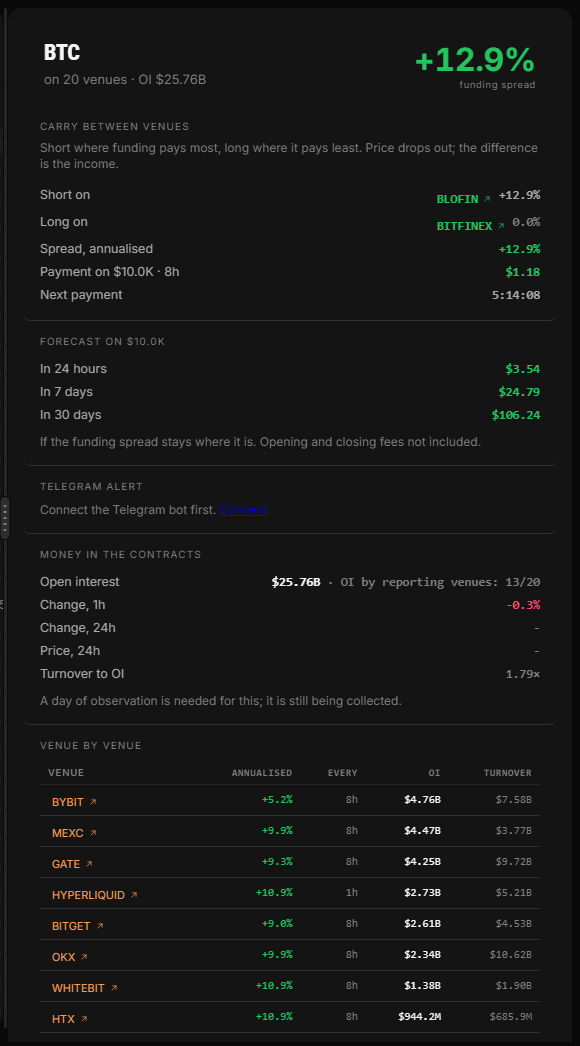
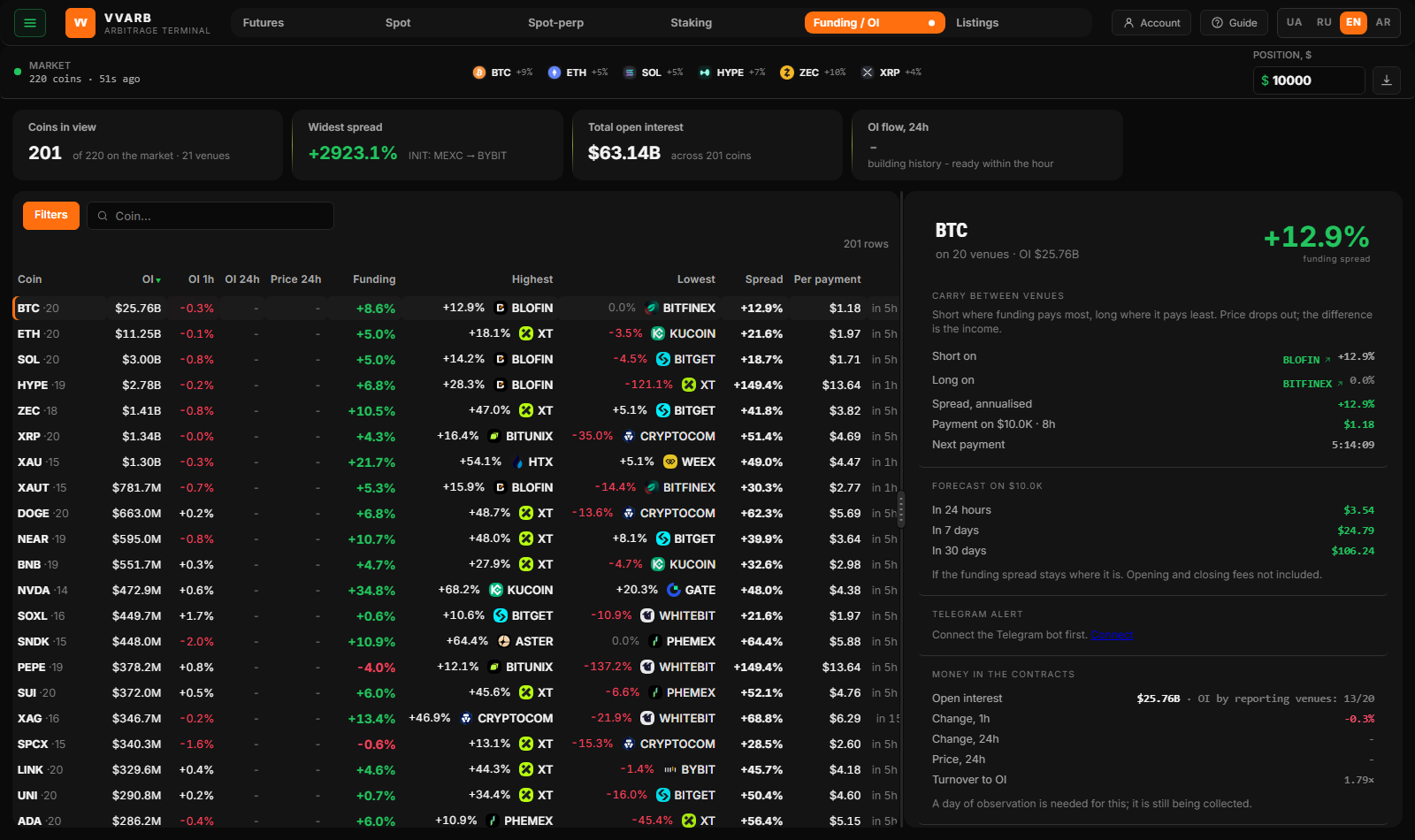
- Every coin’s rate on every exchange - annualised, with the payment interval, turnover and the venue’s open interest.
- Average funding weighted by open interest. A venue with $500M in the contract counts for more than one with $50K.
- Highest, lowest and the spread - ready-made carry legs, chosen only among contracts with $1M+ daily turnover.
- What it pays per settlement on your size, and when the next one is.
- Open interest change over 1h and 24h with a short reading: longs coming in, shorts coming in, shorts covering or longs closing.
- Filters: shorts paid or longs paid, minimum rate, minimum number of venues listing the coin.
- Honest gaps: a venue that did not report a rate is not counted as zero and does not drag the average.
Open interest: where the money in the contracts is going
Open interest (OI) is the total of all open positions in a contract. It rises when positions are opened and falls when they are closed. Read together with price: OI up with price up - longs coming in; OI up with price down - shorts coming in; OI down with price up - shorts covering; OI down with price down - longs closing. The screener writes this reading straight into the coin card.
The server records open interest every five minutes and keeps the history on disk, so the hour and day columns do not reset after a release. The change is measured over the same set of venues at both ends: a venue that starts or stops reporting OI is not passed off as money flowing in. How to use the signal: open interest.
How to use the funding screener
Sign up
The funding and OI table opens straight after sign-up - all of it, every filter, on data eight hours old.
Pick a direction
"Shorts paid" keeps coins where the short receives funding, "longs paid" the opposite. Cut out coins that trade on too few venues.
Sort by spread
The top rows are the coins with the widest rate gap between liquid venues - carry candidates.
Open the coin card
Check the rate on each venue, the payment interval, turnover, time of the next payment and where open interest is heading.
Put the trade on and watch it
Short the expensive leg, long the cheap one, equal size. Close it once the spread has shrunk too far to cover the fees.
Sign up in a minute
Risks of funding arbitrage
| Risk | What happens | What to do |
|---|---|---|
| The rate flips | A few payments later the expensive leg is the cheap one | Watch the spread, not one rate, and hold only while it lives |
| Different intervals | One venue pays hourly, another every 8 hours | The screener annualises everything, so legs compare |
| One leg liquidated | A sharp move takes out a leveraged position | Moderate leverage and spare margin on both venues |
| Illiquid contract | Huge rate, no size behind it | Legs only from contracts with $1M+ daily turnover |
| Fees | A short-lived trade does not pay for entry and exit | Count income over the whole term, as in the example |
Funding arbitrage reduces price risk but does not remove it: rates change, and legs on different exchanges are liquidated independently. The screener finds and prices the gap; the decision and the execution stay with you.
Free and with a subscription
| Item | Free | Subscription |
|---|---|---|
| Funding and OI table, every filter | Yes | Yes |
| Per-venue coin card | Yes | Yes |
| Data | 8 hours behind | Real time |
| Spot, futures and spot-futures screeners | Delayed | Real time |
The eight-hour delay is deliberate: at least one settlement passes in that time, so the free table shows rates already paid rather than ones still running. Current rates with no delay and no sign-up are on funding rates now.
Questions about funding and open interest
What do positive and negative funding mean?
Positive - longs pay shorts, the perpetual trades above spot. Negative - shorts pay longs. The screener shows the rate from the side that receives it: the short when positive, the long when negative.
How does the screener compare venues with different intervals?
Every rate is annualised using its own venue’s interval: 1, 4 or 8 hours. So 0.01% an hour and 0.01% per 8 hours do not look the same.
How many exchanges does the funding screener cover?
22 futures exchanges: Binance, Bybit, OKX, Gate.io, Bitget, MEXC, KuCoin, HTX, BingX and others - the same data the VVARB futures screener runs on.
Why does a coin with a huge rate have no carry trade?
Carry legs come only from contracts with at least $1M daily turnover. A huge rate on an illiquid contract usually means it is pinned at the venue’s cap, and real size will not fit.
What does the open interest change tell me?
How much money came into the contracts or left them over the last hour and day. Together with price it hints at who is active: new longs, new shorts or positions closing.
How is this different from the "Funding rates" page?
The funding rates page is an open table of current rates, no sign-up. The screener in the terminal adds the spread and carry legs, OI-weighted averages, a coin card with open interest history, and filters.
What does access cost?
After sign-up the screener is free on data eight hours old. A subscription from $19.92 a month makes it live and opens the other screeners in real time.
Read more: funding arbitrage, how a funding rate works, open interest, delta-neutral strategy. Price spreads between perpetuals are what the futures arbitrage screener hunts.
See who is getting paid right now
Sign-up is free: the funding and open interest table opens in full, on data eight hours old. A subscription makes it live - the rate on screen is the one running now.
VVARB is growing and developing fast, so prices will go up too. Subscribe at today's prices while you can!