Tool · staking with a hedge
Staking with a hedge: yield without betting on the price
A high APY on a coin that can halve is not a yield, it is a coupon on a risk. Delta-neutral staking takes the price out of the equation: the coin earns interest while a perpetual short of the same size sits against it. What is left is the interest plus whatever funding the short collects. The VVARB screener lines up the rates of Binance, Bybit, OKX and Gate.io and thousands of DeFi pools, each with its best hedge, and shows money on your capital instead of a pretty APY.
3-day trial without a data delay.
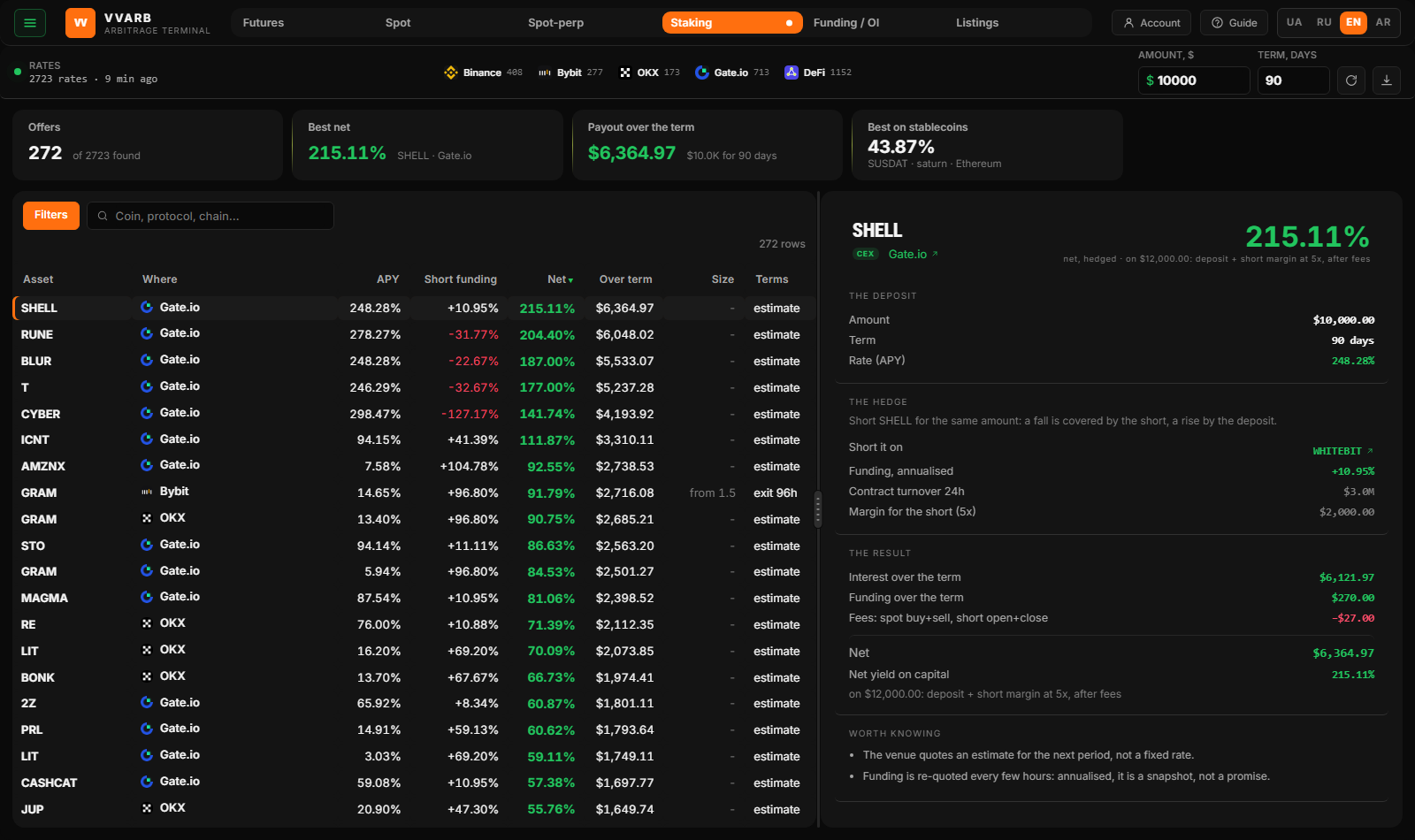
What staking with a hedge is
Plain staking is a bet on the coin: the interest drips in, but if the price drops 30%, no APY covers it. Staking with a hedge - a delta-neutral strategy - works differently. You buy the coin and put it in an exchange earn product or a DeFi pool, and open a perpetual short of the same size. The coin falls - the short makes exactly as much; it rises - the reverse. The price drops out of the result.
What stays: the staking interest and the short’s funding. When the perpetual trades above spot, longs pay shorts and funding adds to the APY. When funding is negative, the short pays and it is subtracted. The screener picks, for each rate, the venue where the short pays best right now and totals it up. The mechanics in detail: staking with a hedge.
Where the rates come from
Rates are collected from the public APIs of four exchanges - Binance, Bybit, OKX and Gate.io - and from DefiLlama for DeFi pools with real TVL. A rate we cannot confirm with a request is not in the table: exchanges whose earn products are only visible to a logged-in account are left out. Beside every rate you see whether it is tiered (the headline rate applies only to the first slice of the deposit), whether it is an estimate for the coming period, and how many hours it takes to get out of the product.
A worked example: $5,000 at 10% APY, hedged for 90 days
| Staking interest: 10% a year × 90 days | +$123.29 |
| Short funding: 8% a year × 90 days | +$98.63 |
| Fees: buy and sell the coin 2 × 0.1%, open and close the short 2 × 0.05% | −$15.00 |
| Total for 90 days | +$206.92 |
| Short margin at 5x | $1,000 |
| Capital at work: deposit + margin | $6,000 |
| Net yield on capital | 13.99% a year |
The yield is on all of the capital, including the short’s margin, which earns nothing itself, and after all four trades. With zero funding the same position would make $108.29, or 7.32% a year on capital. The coin price is not in the sum: if it fell 30%, the deposit would lose $1,500 and the short would make the same.
Funding changes every few hours. The screener shows its current annualised value - a snapshot, not an income guaranteed for the whole term.
What the staking screener shows
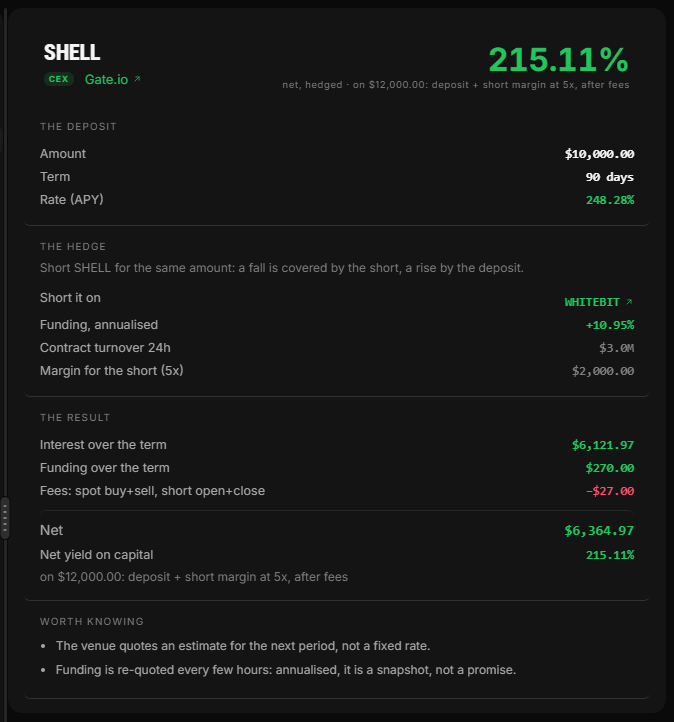
- APY and net yield side by side. Net is on capital - the deposit plus the short’s margin at 5x - after spot and futures fees.
- The best hedge for every rate - the venue paying the short the most among contracts with $2M+ daily turnover.
- An amount and term calculator: what the interest pays, what funding adds or takes away, what margin the short needs.
- Stablecoins on their own. USDT, USDC and other stables carry no price risk, so no hedge - just the plain yield.
- An EUR/USD flag for EURC and EURS: pegged to the euro rather than the dollar, so the exchange rate is your risk.
- A "funding at the limit" flag for rates above 150% a year: they last hours, and such a hedge is offered only when nothing else will carry the short.
- Honest terms: tiered rates, estimates rather than fixed rates, two-asset pools and the time it takes to exit.
Why high funding is not a guarantee
Funding is repriced every few hours, so an annual figure is a snapshot of now, not a year’s yield ahead. +200% a year only means shorts are being paid very generously at the moment - usually because the coin is overbought, and that passes. That is why the table has a "cut above" slider: it removes three-digit rates and keeps the ones with a chance of lasting. And a hedge on a contract with negligible turnover is not offered at all: the rate there is real, the trade is not.
How to use the screener
Sign up
Hedged staking and listings have a 3-day trial. Afterwards, an arbitrage subscription is required.
Set amount and term
The screener turns every rate into money: interest, funding, fees, margin and net yield on capital.
Filter out the noise
Drop rates with funding at the limit, tiered products, two-asset pools and coins with no liquid hedge.
Check the terms
In the rate card, look at the deposit cap, the exit time and the venue for the short.
Open both legs
Buy the coin and stake it, and open a short of the same size at moderate leverage. Keep an eye on funding: if it turns persistently negative, rethink the hedge.
Sign up in a minute
Risks of delta-neutral staking
| Risk | What happens | What to do |
|---|---|---|
| Funding flips | The short starts paying and the yield falls below the APY | Watch the net yield, not the APY, and revisit the hedge |
| Short liquidated | The coin spikes and the margin is not enough | Moderate leverage and spare margin on the futures venue |
| Exit time | The deposit takes hours or days to release while the short is closed | Check the exit time and close both legs together |
| Tiered rate | The high rate applies only to the first few hundred dollars | The screener flags such rates |
| Two-asset pool | A short on one coin does not cover the pair drifting apart | Such pools are never sold as delta-neutral |
The hedge removes the coin’s price risk, not exchange, smart-contract or liquidation risk. The screener finds and honestly prices the rates; the decision and the execution stay with you.
Questions about staking with a hedge
What is delta-neutral staking?
Staking a coin while holding a perpetual short of the same size. The short offsets price moves, and the return is the staking interest plus funding.
Which exchanges and sources are covered?
Binance, Bybit, OKX and Gate.io through their public APIs, plus DeFi pools from DefiLlama with real TVL - thousands of exchange rates and pools in all.
Where is the hedge short opened?
The screener finds a perpetual on the same coin across the futures exchanges and picks the one paying the short best right now, among contracts with $2M+ daily turnover.
How is the net yield calculated?
Staking interest plus short funding minus four fees (coin buy and sell, short open and close), divided by capital: the deposit plus the short’s margin at 5x. Simple interest, not compounded.
Do stablecoins need a hedge?
No. Stables carry no price risk, so they are listed separately with no hedge. The exception is EURC and EURS: they track the euro, and the screener flags the EUR/USD risk.
What does "funding at the limit" mean?
Funding above 150% a year. Such rates usually last hours, not months, so the screener does not present them as an annual yield and offers such a hedge only when there is no other.
What does access cost?
Hedged staking and listings have a 3-day trial. Afterwards, an arbitrage subscription is required.
Read more: staking with a hedge, delta-neutral strategy, how a funding rate works. Funding on every venue is in the funding and open interest screener; hedging spot with a perpetual on a price gap is the spot-futures screener.
Run it on your own numbers
Hedged staking is available during a 3-day trial.
VVARB is growing and developing fast, so prices will go up too. Subscribe at today's prices while you can!