P2P arbitrage vs cross-exchange arbitrage
In crypto the word "arbitrage" covers two very different things. P2P arbitrage is reselling crypto between people for ordinary money via bank cards and payment services. Cross-exchange arbitrage is trading inside exchanges where a coin's price differs between venues. Here is how they differ in money, time and risk.
All seven screeners once you sign up
What P2P arbitrage is
On exchanges' P2P marketplaces people buy and sell crypto to each other for fiat money: card transfers, payment services or cash. Every seller sets their own rate. A P2P arbitrage trader buys USDT or another coin cheaper from some and sells it dearer to others - on the same marketplace, another exchange, or across payment methods.
What cross-exchange arbitrage is
No fiat is involved. A coin is bought for USDT on one exchange and sold on another where it is dearer, or a position is locked on the futures of two exchanges. Funding rate arbitrage and spot-futures arbitrage belong here too. The counterparty is an order book, not a particular person.
Comparison
| Item | P2P arbitrage | Cross-exchange arbitrage |
|---|---|---|
| Source of profit | Different buy and sell rates across people and payment methods | Price differences between exchanges, funding, basis |
| Counterparty | A particular person | An exchange order book |
| Money | Fiat on cards plus crypto | Crypto only |
| Trade speed | Minutes to hours, depends on replies and payments | Seconds per trade, minutes per transfer |
| Manual work | A lot: chats, checking payments | Less: finding the route and executing |
| Main risks | Frozen cards, fraud, reversed payments | Closed withdrawals, liquidation, slippage |
| Requirements | Bank cards, checks, limits | Exchange accounts, verification |
P2P risks
- Frozen cards and accounts. Banks often treat many incoming transfers from different people as suspicious and restrict the account.
- "Dirty" money. A buyer's money can be part of a fraud scheme, and the recipient then comes under review.
- Fraud. Fake payment receipts, payments reversed after the coin is received, pressure on the seller.
- Time. Trades depend on how quickly people and banks respond.
- Legal status. Regularly reselling currency for profit may require registering the activity, depending on the country.
Cross-exchange arbitrage risks
- Closed withdrawals or deposits, network delays.
- A futures leg getting liquidated.
- Slippage and the spread changing during execution.
- Exchange risks: outages, accounts held for review.
They are covered in detail in the arbitrage risks article.
A comparison on $1,000
| Bought USDT for fiat | at a rate of 1.000 |
| Sold USDT to another person | at a rate of 1.078 |
| Difference | +7.8% |
| Time per round | 30-90 minutes |
| Risk of freezes and disputed payments | present |
Illustrative numbers: P2P spreads depend heavily on the country, payment method and time of day.
| Bought the coin on exchange A | 7.0% cheaper |
| Fees and withdrawal | −0.4% |
| Slippage | −0.2% |
| Result | ≈ +6.4% |
| Time | 5-15 minutes |
Income per round is usually smaller, but there are no fiat transfers and no dealing with people.
Which to choose
- P2P suits those ready to spend time dealing with buyers and sellers who understand their country's banking risks.
- Cross-exchange arbitrage suits those who want to work only inside exchanges, with clear fees and no card operations.
- Many combine them: P2P to bring money in and out, cross-exchange to work with the capital inside the exchanges.
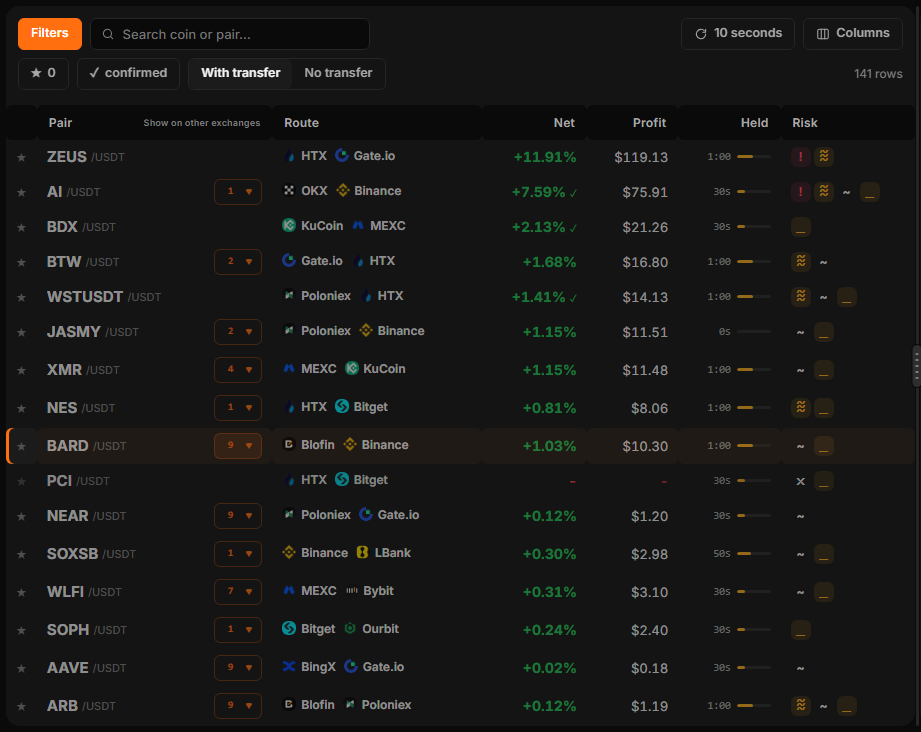
VVARB is a cross-exchange arbitrage scanner: spot, futures, spot against futures, funding and hedged staking. It does not track P2P rates.
Glossary
- P2P (peer-to-peer) - trades directly between people through an exchange's marketplace.
- Fiat - ordinary money in cards and bank accounts.
- Merchant - a P2P seller who posts offers continuously.
- Cross-exchange arbitrage - profiting from a coin's price difference between exchanges.
- Route - a specific coin and pair of exchanges with a price difference.
P2P and cross-exchange arbitrage FAQ
How does P2P arbitrage differ from cross-exchange arbitrage?
In P2P the profit is the rate difference when swapping crypto for fiat with particular people. In cross-exchange arbitrage it is the coin's price difference between exchanges, with no fiat involved.
Which pays more?
P2P can pay a higher percentage per round but takes more time and carries banking risk. Cross-exchange usually pays less per trade but is faster and involves no card operations.
Can my card be frozen doing cross-exchange arbitrage?
Cross-exchange arbitrage itself does not touch cards: the money stays in crypto inside the exchanges. The bank is involved only when depositing or withdrawing money.
Do I need verification?
Most exchanges require identity checks for withdrawals and P2P. Better to complete it in advance so you do not hit limits mid-trade.
Can I combine both?
Yes. P2P is often used to move money in and out, and cross-exchange arbitrage to work with capital inside the exchanges.
Does VVARB show P2P rates?
No. The scanner works with exchange prices: spot, futures, funding and staking yields.
Free after sign-up · no time limit